What You’ll Learn
audience saturation in ppc
Key Takeaways
- Intent saturation is when the highest-quality demand is already captured – after that, extra spend reaches less ready, less precise intent and performance feels worse without anything “breaking”.
- Scaling changes the intent mix – campaigns move from bottom-funnel demand into comparison and research queries, lowering marginal ROAS and lead quality while volume can still rise.
- The demand curve bends before dashboards panic – early gains accelerate, then flatten as auction pressure and signal dilution increase costs and reduce conversion probability.
- Don’t confuse saturation with fatigue – audience saturation is repeated exposure to the same people, while ad fatigue is repeated exposure to the same creative; both can look similar, but intent saturation is a demand constraint.
Most PPC accounts don’t fail because ads get worse.
They fail because scale changes what you’re buying.
You’re probably here because performance shifted after budget increased.
CPAs crept up.
Lead quality softened.
ROAS feels less predictable.
Nothing obvious broke.
Here’s the uncomfortable truth: the constraint is rarely audience saturation first.
It’s Intent Saturation.
Here’s the name for it.
Intent Saturation is the moment your campaigns have already absorbed the most ready-to-act demand, so incremental budget starts purchasing less precise, less urgent intent instead. That’s why scale feels inconsistent even when execution stays constant.
High-intent demand means the user is already close to a decision.
They’re searching pricing, demo, near me, quote.
Those searches convert fast.
But there are only so many of them in a given month.
You’re probably thinking, “Isn’t this just ad fatigue?”
No.
Ad fatigue is creative freshness.
Audience saturation is overexposure.
Intent saturation is demand quality.
And demand quality changes before anything in the interface looks broken.
Here’s where most teams get misled.
Early wins feel like proof of infinite scalability.
They are not.
They are proof that you harvested the ripest demand first.
Ignore that distinction and you’ll chase surface fixes while the real shift is structural.
This article explains the mechanics behind that structural shift.
No tactics.
No setup advice.
Just the mechanics that make scale bend.
This page sits inside our broader guide to PPC and Paid Media as a system of demand, auctions, and constraints – not just ads.
Because once you understand where quality bends, you stop misdiagnosing performance shifts.
And the next time spend increases, you’ll know what actually changes under the surface.
PPC performance weakens at scale not because ads degrade, but because the intent mix changes.

What intent saturation is (and what it isn’t)
- Intent saturation in PPC is when your campaigns have already captured the most ready-to-act demand, so incremental spend buys less precise, less urgent intent.
- It is not audience saturation (the same people seeing ads too often).
- It is not ad fatigue (creative losing novelty).
- It is demand quality thinning before anything “breaks” in the interface.
Key terms used on this page
- High-intent demand: searches close to action (pricing, demo, quote).
- Marginal intent: relevant interest with lower urgency or weaker fit.
- Blended ROAS: average return across all spend.
- Marginal ROAS: return produced by the next increment of spend.
This page explains why PPC scale changes lead quality.
It does not cover setup, keyword selection, or bidding.
Early gains: the finite pool of high-intent demand
The first $5,000 often looks brilliant.
The next $15,000 feels confusing.
You’ve seen it.
Early CPAs look efficient.
ROAS looks strong.
The board gets comfortable.
Then you scale.
And something starts slipping.
Execution stayed constant.
Yet performance shifts.
Here’s what’s actually happening.
You are hitting the High-Intent Pool first.
Let’s define that clearly.
The High-Intent Pool is the concentrated group of users already close to a buying decision within a given time period. It includes bottom-funnel searches, branded demand, urgent needs, and comparison queries.
This pool is finite.
There are only so many people typing “pricing”, “request demo”, or “get quote” this month. That number does not expand just because your budget does.
Early performance feels strong because you intercept these users first, while decision readiness is high and friction tolerance is low.
That’s why the first spend often performs disproportionately well.
We saw this with a B2B software client.
At $8,000 per month, demos came in at $92 CPA.
At $22,000, CPA rose to $147 within six weeks.
No structural changes were made.
They simply consumed more of the High-Intent Pool.
Here’s the negative frame most teams ignore:
If you treat early efficiency as a scalable baseline, you will overestimate future returns and misdiagnose the inevitable decline as execution failure.
It isn’t failure.
It’s depletion.
Picture a narrow tap at the top of a tank.
The first liters flow fast and clean.
As pressure drops, output slows and impurities increase.
Scale behaves the same way.
You begin inside a dense cluster of decisive demand.
As budget rises, you move outward into less certain territory.
This is the moment most teams misinterpret.
Early wins feel like proof of unlimited headroom.
They are not.
That’s why the next budget tranche behaves differently.
And once that concentrated layer is absorbed, the equation changes.
So the real question becomes:
If the top layer is finite, what happens when you move beyond it?
Because that’s where scale stops feeling easy.
Early PPC gains are front-loaded by a small, finite High-Intent Pool. Once that pool thins, incremental spend behaves differently.

Intent hierarchy: why marginal intent increases CPA
Not all clicks are equal.
They never were.
When you scale PPC, you don’t just buy more traffic.
You buy traffic from a different layer of intent.
This is where the next concept matters.
Let’s call it the Intent Hierarchy.
The Intent Hierarchy ranks demand by decision readiness, from immediate purchase intent down to early-stage curiosity. As spend increases, campaigns consume the highest layers first, then expand downward into less decisive territory.
At the top of the hierarchy:
- “enterprise CRM pricing”
- “cybersecurity demo request”
- “rehab center near me”
These users are close to action.
Below that:
- “best CRM software”
- “HubSpot vs Salesforce”
- “top rehab programs”
Still valuable.
But less urgent.
Further down:
- “how to improve sales process”
- “why does anxiety increase”
- “ways to secure company data”
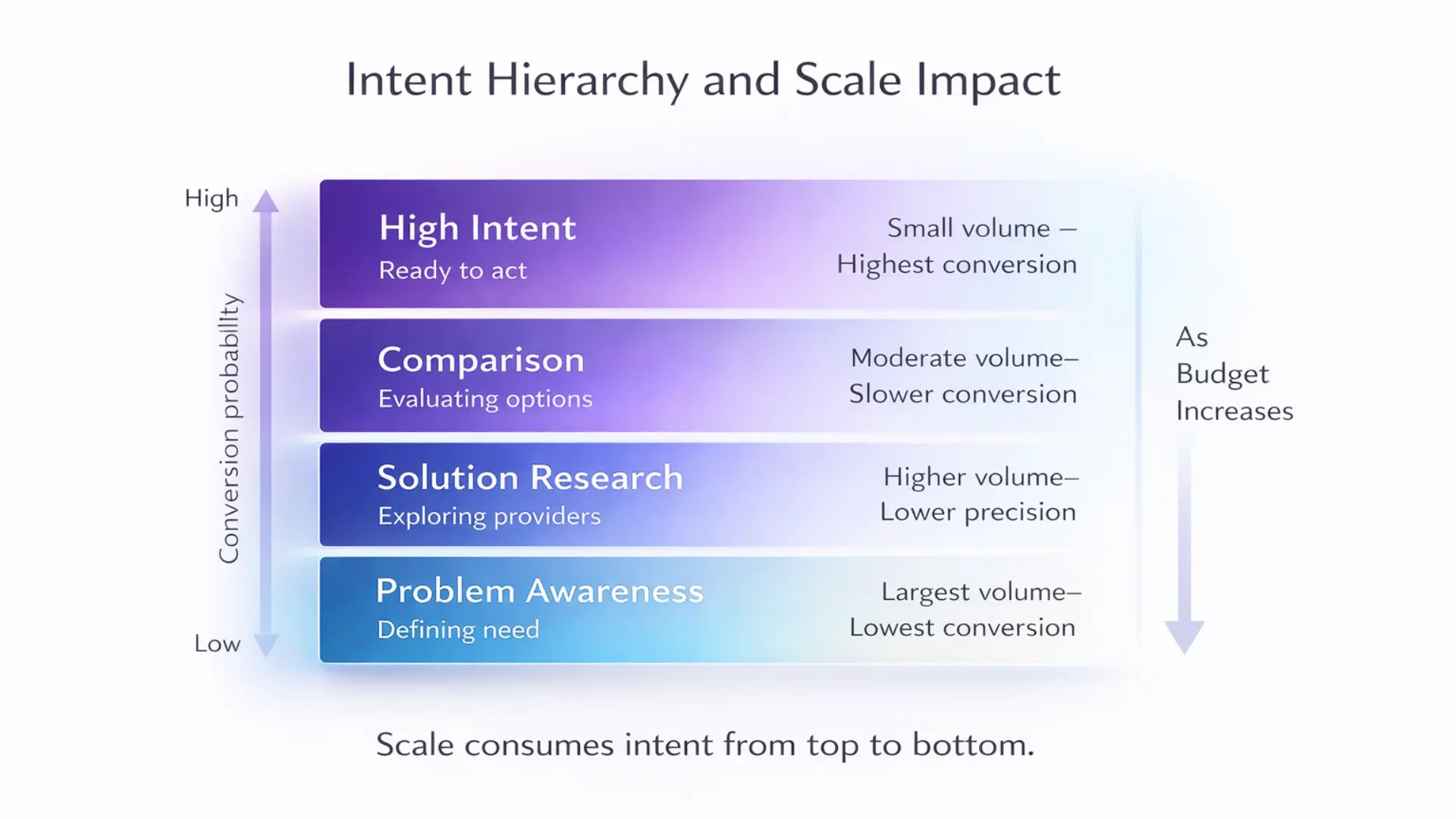
Relevant, yes.
Ready to buy this quarter?
Often not.
Here’s the shift most teams miss.
As budgets grow, campaigns naturally consume the top layers first. Once those are saturated, incremental spend moves into what we’ll name Marginal Intent.
Marginal Intent refers to users who are less certain, less urgent, or less aligned with immediate purchase behavior. They may convert eventually – but at lower rates and higher acquisition costs.
You’re probably thinking:
“But the queries still look relevant”.
Exactly.
That’s why this is dangerous.
Relevance and readiness are not the same.
We saw this clearly with a healthcare client who scaled paid search by 60% over three months.
Top-funnel traffic doubled.
Demo requests increased only 18%.
Sales-qualified leads dropped 9%.
The dashboard showed growth.
Sales felt dilution.
That dilution is the result of marginal intent entering the mix.
Here’s the structural consequence:
High-intent users convert at higher rates, tolerate higher CPCs, and move through the funnel faster.
Marginal-intent users click more cautiously, compare more options, and hesitate longer.
That hesitation changes the economics.
Conversion rate softens.
CPC rises as competition spreads into broader queries.
Cost per acquisition expands from both sides.
This is not volatility.
It’s math.
Imagine filling a room with the most motivated prospects first.
As you keep inviting people, attendance increases – but average motivation per person declines.
Scale increases volume.
It decreases average intent density.
And once intent density falls, performance starts bending in a very specific way.
Which leads to the next structural question:
If intent shifts downward as spend increases, what shape does performance take over time?
Because it does not move in a straight line.
As budgets rise, campaigns slide down the Intent Hierarchy into Marginal Intent. That shift lowers conversion efficiency even when relevance remains intact.

Demand curves: where the bend becomes visibleRevenue does not rise in a straight line.
Spend doesn’t either.
When you scale PPC, performance follows a shape. Not a guess. Not randomness. A shape.
This usually shows up as a response curve: early acceleration, then flattening as intent thins.
It unfolds in three predictable phases.
1) Accelerated Phase
Small budget.
Dense high intent.
Strong marginal returns.
This is where early results feel effortless.
Marginal ROAS is high because each additional dollar still taps concentrated readiness.
2) Linear Phase
Moderate budget.
Stable but thinning intent.
Returns normalize.
Performance still looks healthy.
But marginal efficiency is already slipping quietly.
3) Plateau Phase
Larger budget.
Weaker marginal intent.
Efficiency compresses.
Here’s the metric that exposes the shift: Marginal ROAS.
Marginal ROAS is the return on the next dollar spent. It tells you what incremental budget produces, not what past budget produced.
Most teams watch blended ROAS.
That’s the average.
Averages hide inflection points.
We modeled this for a SaaS client.
At $10,000 monthly spend, blended ROAS sat at 420%.
After a 25% budget increase, marginal ROAS fell to 210% within four weeks.
Total ROAS still looked strong.
The incremental layer told the real story.
You’re probably thinking:
“If blended performance is healthy, does marginal really matter?”
Yes.
Because scale decisions are made on incremental spend, not historical averages.
Here’s the negative frame executives overlook:
If you fund scale based on blended averages, you will approve growth that quietly reduces capital efficiency.
That reduction compounds.
Why does the curve bend?
Because incremental spend pushes into:
- Broader queries
- Higher auction competition
- Lower intent density
CPC rises.
Conversion rate softens.
Both move at once.
Picture walking across firm ground after heavy rain.
The first steps feel solid.
After enough passes, the soil gives way.
Nothing dramatic happens at the exact moment it starts.
But the structure weakens gradually.
That’s what the plateau phase feels like.
It rarely crashes.
It compresses.
And once compression begins, further scale becomes progressively more expensive – even if volume still grows.
Which leads to the deeper mechanism underneath the curve:
If the shape is predictable, what exactly changes inside the system as budget rises?
Because something expands before performance drops.
PPC scale follows a Response Curve. Marginal ROAS declines before blended ROAS does, revealing where efficiency starts bending.Revenue does not rise in a straight line.
Spend rarely behaves that way.
In paid media, performance usually follows a demand curve.
It’s the same response-curve logic used in marketing mix models to explain saturation.
At first, results accelerate.
Then they grow steadily.
Then they flatten, because you’re buying weaker intent at higher auction pressure.
Three phases show up again and again:
- Accelerated phase – small budget, high intent, strong marginal ROAS
- Linear phase – moderate budget, stable but thinning intent
- Plateau phase – larger budget, marginal ROAS declines, efficiency compresses
Marginal ROAS means the return on the next euro spent.
It tells you what your additional budget will produce, not what your past budget produced.
We once modeled this using a simple response curve for a SaaS client.
At $10,000 monthly spend, blended ROAS was 420%.
When we tested a 25% increase, marginal ROAS dropped to 210% within four weeks.
The total number still looked healthy.
The incremental number told the real story.
Finite high intent demand creates that plateau.
Once the concentrated pool is captured, additional spend pushes into less precise queries, broader audiences, or higher auction pressure.
CPC rises and conversion rate softens as spend pushes into weaker intent.
It feels sudden.
In reality, the shift started weeks earlier.
Picture a field after heavy rain.
The first steps are firm.
After enough passes, the ground gives way.
That is saturation in motion.
And when the curve flattens, scale starts costing more than it appears.
So if the curve bends naturally, what exactly weakens inside the system?
Once the curve flattens, the system must expand.
What exactly expands first?

Signal dilution: what expands before performance drops
Platforms reward precision.
They punish ambiguity.
When budgets rise, the system has one job: spend the money. And when high-intent inventory thins out, the only way to spend more is to expand the definition of “qualified”.
That expansion is subtle.
You don’t see a switch flip.
You see more volume.
This is signal dilution: algorithms broaden matching to keep spending.
High-intent signals are strong.
Exact-match searches.
Repeat visitors.
Highly aligned behaviors.
As those become exhausted, the system leans on weaker proxies:
- Broader queries
- Looser audience matches
- Similar-looking users with thinner behavioral alignment
The interface still shows growth.
But the intent mix changes underneath.
You’re probably thinking:
“If the algorithm is optimizing, shouldn’t it protect quality?”
It does optimize.
But it optimizes within the available inventory.
When high-intent supply runs thin, optimization shifts toward probability instead of certainty.
We saw this with a fintech client.
At $12,000 monthly spend, marginal ROAS stayed above 300%.
At $20,000, reach continued climbing – but marginal ROAS slipped below 180% within five weeks.
Traffic volume looked impressive.
Engagement per user declined.
That’s Signal Dilution in motion.
Here’s the structural pattern:
| What expands as you scale | What weakens underneath | What you see in reports |
| Query breadth | Intent precision | More clicks, softer outcomes |
| Similar audiences | Signal strength | Stable volume, lower CVR |
| Auction exposure | Cost efficiency | Rising CPC |
| Incremental reach | Decision readiness | Marginal ROAS declines |
Nothing looks “broken”.
But something is stretching.
Auction pressure amplifies this.
Diagnostic fingerprints of signal dilution
- More clicks, fewer qualified outcomes → intent precision is weakening.
- CPC rising without pipeline growth → broader auction exposure under thinner intent.
- Blended ROAS steady, marginal ROAS falling → incremental spend is buying weaker demand.
- Sales says “just exploring” → decision readiness in the funnel has shifted.
As you compete for incremental impressions, you enter auctions with users who are less decisive. Competition increases while purchase probability decreases.
That combination compresses efficiency.
Here’s the myth worth dismantling:
“If performance drops, creative must be stale”.
Sometimes, yes.
Often, no.
If creative is the issue, performance dips sharply and rebounds when refreshed.
If intent is saturated, refreshes barely move the needle.
That distinction saves quarters.
Think of tuning a radio.
At the exact frequency, the signal is crisp.
Drift slightly, and static creeps in – even though volume stays high.
Scaling increases volume.
Signal clarity decreases.
And when clarity drops, outcomes shift before averages do.
Which is why sales feels it first.
They hear hesitation in conversations before dashboards show compression.
So the next question becomes unavoidable:
If signal weakens gradually, where does the impact become undeniable?
It shows up in lead quality.
As budgets rise, algorithms broaden matching. Signal strength weakens before dashboards reflect it, and efficiency compresses quietly.

Lead quality decline: how intent saturation shows up first
Sales teams notice before dashboards do.
They always do.
“Leads feel different”.
That sentence shows up before any red flag in the interface.
Volume can rise.
CPL can look manageable.
Blended ROAS can hold steady.
Yet conversations shift.
This is where lead quality starts slipping before dashboards show it clearly.
We saw it with a behavioral health client that scaled spend 40% in one quarter.
Lead volume rose 28%.
Cost per lead increased 19%.
Admissions dropped 7%.
On paper, performance looked acceptable.
Inside the call center, qualification declined week by week.
Nothing in targeting changed.
Nothing in creative changed.
The intent mix changed.
You’re probably thinking:
“If CPL is still within range, why does this matter?”
Because CPL measures cost of acquisition at the click-to-lead level.
Revenue is created further down.
Lower-intent users behave differently:
- They ask more exploratory questions.
- They compare more competitors.
- They delay decisions.
- They no-show more frequently.
That hesitation stretches the sales cycle.
Stretching the cycle increases operational cost.
At the same time, auction pressure rises in broader segments.
So two forces move together:
CPC climbs.
Conversion rate softens.
When both shift simultaneously, ROI compresses quickly.
We saw the same pattern with an enterprise cybersecurity brand.
At $30,000 monthly spend, demo-to-opportunity rate was 41%.
At $50,000, it dropped to 29%.
Messaging stayed the same.
Landing pages stayed the same.
Creative refreshes didn’t reverse it.
Because the system wasn’t broken.
It expanded.
And expansion diluted readiness.
Here’s the negative frame executives miss:
If you interpret Quality Compression as a creative problem, you will keep optimizing surface variables while the structural constraint tightens underneath.
That wastes time.
Picture a retail store.
The first customers entering are ready to buy.
As foot traffic increases, more browsers enter.
Revenue still happens – but effort per sale rises.
Scale increases throughput.
It reduces average decisiveness.
And sales feels decisiveness before marketing sees efficiency drift.
This is the point where leadership often asks:
“Is the channel failing?”
Usually, no.
The channel is behaving exactly as designed.
When intent density falls, downstream conversion probability falls with it.
That’s not volatility.
That’s composition shift.
The next and final layer is recognition.
Because intent saturation does not collapse performance.
It erodes it.
When scale shifts toward marginal intent, lead quality compresses before dashboards clearly reflect it.

Recognising intent saturation
Intent saturation does not announce itself.
It leaves fingerprints.
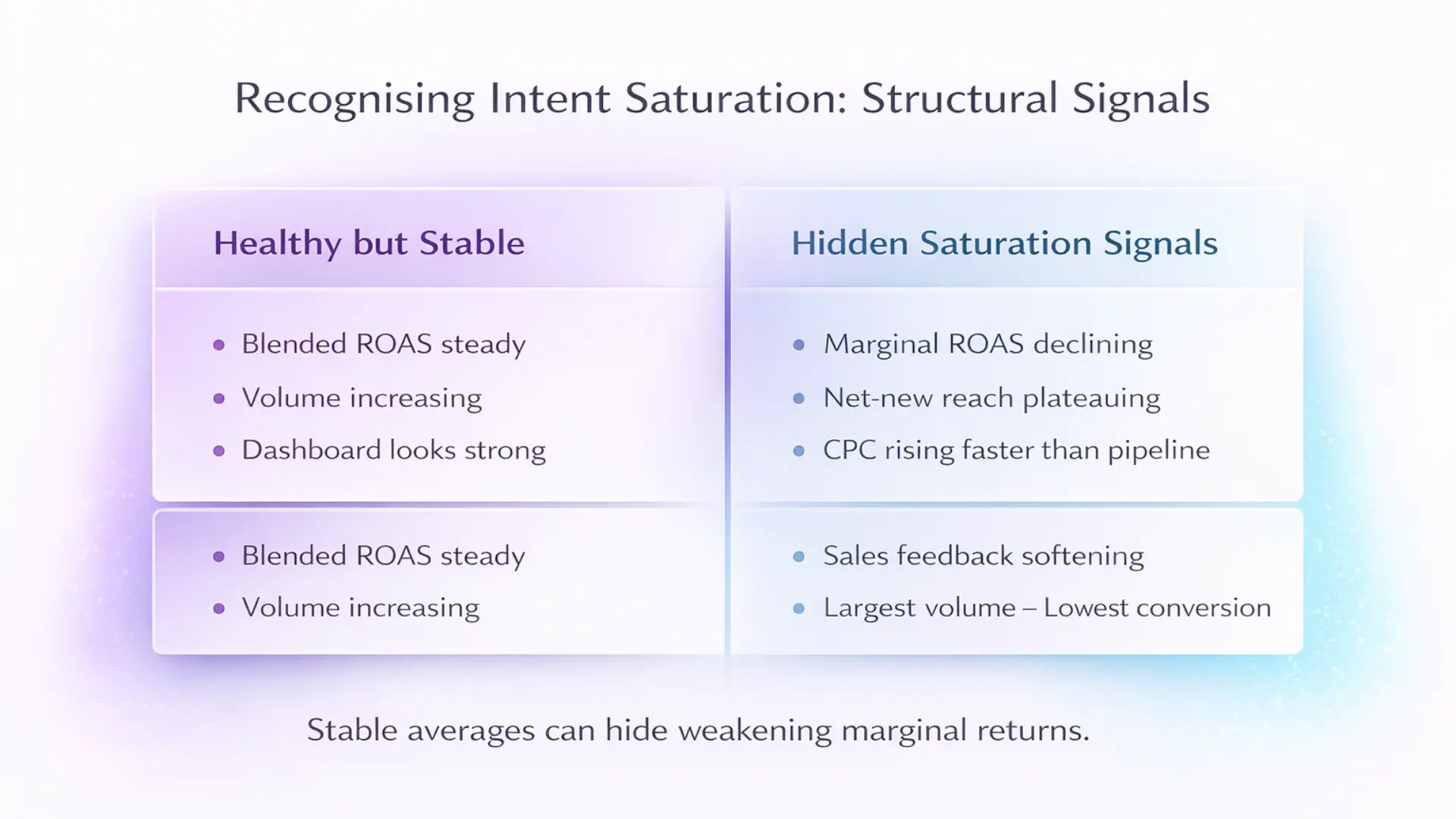
Fast diagnostic cues:
- Blended ROAS holds while marginal ROAS declines.
- Spend rises while net new reach plateaus.
- CPC increases without a matching rise in qualified pipeline.
- Sales feedback shifts from “ready to buy” to “just exploring”.
You rarely see a dramatic collapse.
You see small drifts that compound.
The danger is not volatility.
It’s divergence.
Let’s name the signal clearly: The Marginal Gap.
The Marginal Gap is the widening difference between blended performance metrics and marginal performance metrics as spend increases. When this gap expands, diminishing returns have already begun – whether you acknowledge them or not.
These are not glitches.
They are structural signals.
You’re probably thinking:
“If overall performance is holding, is this really a problem?”
Yes.
Because growth decisions are funded on the next dollar, not the historical average.
One SaaS client celebrated a blended 380% ROAS.
Yet marginal ROAS on incremental budget fell below 200% within two months.
The total number looked healthy.
The next dollar was far less productive.
That contrast is the signal.
Another B2C healthcare client saw search impression share climb steadily.
Volume grew.
But booked appointments as a percentage of leads declined for eight consecutive weeks.
Nothing obvious changed in the interface.
The intent composition shifted.
This is where executives must think structurally.
Audience saturation and ad fatigue are often blamed first.
But they behave differently.
If creative is tired, performance dips sharply and rebounds with refresh.
If intent is saturated, refreshes barely move the needle.
That distinction saves months of reactive changes.
Imagine driving at night.
The road still exists.
Visibility shortens gradually.
You don’t crash instantly.
You just have less margin.
Intent saturation works the same way.
It narrows the field of high-probability outcomes.
Marginal intent expands quietly.
Once you can name the constraint, you stop chasing random fixes.
And once you see The Marginal Gap, the next phase becomes predictable.
Now we can talk about returns.
Intent saturation reveals itself through divergence between blended and marginal metrics. Spot the Marginal Gap early, and you prevent misdiagnosis.

When intent saturation turns into diminishing returns
Once high-intent demand is captured, growth shifts to marginal intent.
And marginal intent converts at lower efficiency.
That is where PPC diminishing returns begin.
This is not a sudden drop.
It’s a structural shift.
The math becomes simple, even if the dashboard looks complex.
Each additional dollar buys less incremental revenue.
Each expansion step increases acquisition cost faster than volume grows.
That compression has a name: Efficiency Compression.
Efficiency Compression occurs when weaker intent and higher auction pressure combine, reducing marginal returns even while blended averages still look acceptable.**
We saw this with a SaaS client scaling from $25,000 to $40,000 monthly spend.
Revenue increased 22%.
Ad spend increased 60%.
Marginal ROAS dropped below 150% within one quarter.
The blended average masked it.
The incremental return exposed it.
Diminishing returns are not random.
They are the visible phase of intent saturation.
Imagine pouring water into a sponge.
At first, it absorbs quickly.
Then saturation slows absorption even though you keep pouring.
That is the shift from intent saturation to efficiency compression.
When intent weakens, returns change predictably – this is exactly how diminishing returns in PPC take hold.
Scale is possible.
But only when you understand where quality bends before cost breaks.
Diminishing returns are the visible outcome of intent saturation. Efficiency Compression begins the moment incremental spend relies on marginal intent.

Scientific context and sources
The sources below describe the economic, statistical, and algorithmic mechanisms that explain diminishing returns, auction pressure, and signal degradation in large-scale advertising systems. They provide foundational context for the performance patterns described above.
- Diminishing returns and media response curves
Bayesian Methods for Media Mix Modeling with Carryover and Shape Effects – Jin, Yuxue; Wang, Yuting; et al. – Google Research (2017)
Formalizes saturation curves and diminishing-return response functions used in media allocation modeling, explaining why incremental spend produces lower marginal returns beyond a threshold.
https://research.google/pubs/pub46001/ - Auction pressure and generalized second-price dynamics
Position Auctions – Varian, Hal – American Economic Review (2007)
Explains the mechanics of generalized second-price auctions used in search advertising, including how increased competition affects pricing and efficiency.
https://www.sciencedirect.com/science/article/abs/pii/S0167718706001317?via%3Dihub - Large-scale ad click prediction and signal weighting
Ad Click Prediction: a View from the Trenches – McMahan, Holt, Sculley, et al. – Google (2013)
Describes how machine learning systems rely on varying signal strengths for ad prediction and how broader input distributions affect performance outcomes.
https://dl.acm.org/doi/10.1145/2487575.2488200 - Economic theory of diminishing marginal returns
The Law of Diminishing Returns – Samuelson & Nordhaus – Economics (Textbook, multiple editions)
Introduces the economic principle that incremental input produces progressively smaller output gains beyond an optimal level, foundational to performance scaling analysis.
https://studylib.net/doc/27916155/introductory-pages
Questions You Might Ponder
What is intent saturation in PPC?
Intent saturation in PPC occurs when campaigns have already captured most high-intent, ready-to-buy searches. Additional budget then reaches earlier-stage or less qualified users. Performance declines not because ads worsen, but because incremental traffic carries weaker purchase intent and lower conversion probability.
Why does PPC performance drop when I increase budget?
When you increase spend, platforms exhaust the most commercial, bottom-funnel demand first. To maintain volume, algorithms expand into broader keywords and audiences. This expansion lowers marginal ROAS and conversion rate, even if overall traffic increases, because new impressions come from colder intent segments.
How is intent saturation different from audience fatigue or ad fatigue
Intent saturation means high-quality demand has been consumed. Audience fatigue means the same users see ads too frequently. Ad fatigue means creatives lose effectiveness. Fatigue issues often recover with rotation or refresh. Intent saturation does not – it reflects finite demand, not creative decline.
What are early signs that my PPC account is hitting intent saturation?
Common signs include rising CPC with unchanged settings, declining marginal ROAS while blended ROAS stays stable, flattening net-new reach, and sales feedback that leads feel less qualified. These signals point to demand constraints and signal dilution rather than execution errors.
Can PPC still scale after high-intent demand is exhausted?
Yes, but the economics shift. Expect higher CPA and lower marginal returns as campaigns move into comparison and research queries. Sustainable growth at this stage requires stronger nurturing, mid-funnel support, or new demand creation rather than assuming bottom-funnel efficiency will persist.